COULOMB'S INVERSE SQUARE LAW - ELECTROSTATIC FORCE
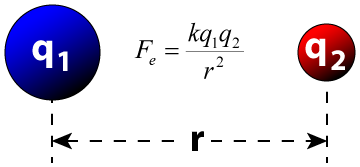
Electrostatic force between two charges
The force between two charges can be calculated using 'coulomb inverse square law'.
Electrostatic force maybe either force of attraction or repulsion.
If two charges q1 and q2 are placed in either vacuum or any medium at a distance r , then the force is attractive if the two charges are opposite are to each other.
if the charges are same then the force is repulsive .
According to Coulomb the electrostatic force is directly proportional to the product of the amount of the two charges and inversely proportional to the square of distance between them.
F ∝ q1 q2 /r^2
F = k q1 q2 /r^2

k is the proportionality constant which depends upon the medium.
K = 1/4πƐ0
F = q1 q2 / 4πƐ0 r^2
Epsilon Ɛ0 Permittivity of free space
if the two charges are placed in any other medium rather than vacuum then electrostatic force between them depends upon the nature of medium.
F = q1 q2 / 4πƐ r^2
Ɛ = permittivity of the medium
The value of permittivity of vacuum Ɛ0 =8.86 x 10 ^-12
Units - N m ^2 C^ -2
and the value of 1/4πƐ0 = 9 X 10 ^9
Electric force is calculated in Newton in S.I units
the charges calculated in coulombs.
Relative permittivity
it is defined as the ratio of permittivity of the given medium to the permittivity of vacuum/ free space.
Relative permittivity is denoted byƐr.
Ɛr= Ɛ/ Ɛ0.
Relative permittivity has no units and dimensions.
it is a constant related to the given medium.
it is also known as dielectric constant if the medium is considered as dielectric medium.


Comments
Post a Comment